
Two diesel-battery hybrid PCS systems can both be advertised at the same power rating and still have very different prices. That is not necessarily a pricing inconsistency.
A kW figure tells buyers how much power a system is rated to process, but it does not describe how the PCS handles diesel generators, batteries, unbalanced loads, overloads, switching, or future expansion.
For a diesel battery (hybrid power system), those differences can materially change the engineering scope. A lower-priced quotation may cover a basic power converter, while another may include grid-forming controls, generator coordination, parallel operation, monitoring, and application-specific integration.
Rated power is only the starting point for comparing hybrid PCS equipment. Two systems with the same nominal output may use different electrical architectures and have different transient capabilities.
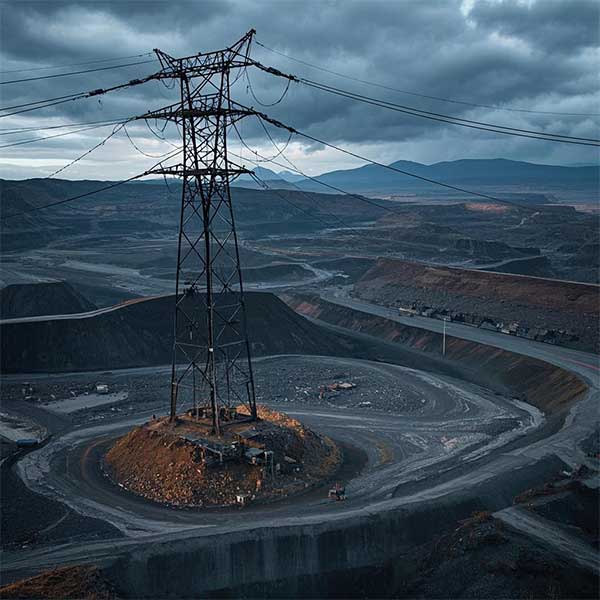
Consider an off-grid mining site. The PCS may need to operate alongside diesel generators while supplying rapidly changing loads. The inverter may also need to absorb or release battery power while maintaining stable voltage and frequency. Those requirements cannot be inferred from the nameplate kW value alone.
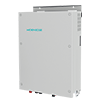
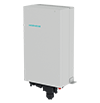
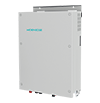
Our diesel-storage hybrid solution uses a transformerless three-phase four-wire architecture and is designed to handle three-phase 100% unbalanced loads. It also specifies 1.5-times overload for three seconds.
Consequently, buyers should compare the operating envelope rather than simply divide the quoted price by rated power. A system capable of handling demanding transient conditions may contain considerably more engineering value than one with the same continuous rating but more limited overload or load-handling capability.
Power-conversion topology has a direct influence on equipment design. Transformerless and transformer-based architectures, for example, can lead to different equipment configurations, footprints, losses, and integration requirements. The correct choice depends on the site's voltage structure and system architecture rather than on price alone.
Load characteristics matter as well. A hybrid microgrid may contain motors, single-phase loads, nonlinear loads, and rapidly changing industrial equipment. Supporting these loads can require more sophisticated current control and protection than a system designed for relatively stable balanced loads.
The same principle applies to hybrid renewable energy systems. Their value comes from coordinating multiple energy resources rather than simply converting battery DC into AC.
A technical study of hybrid PV/diesel/battery systems identifies the generator, inverter, PV system, and battery as separate investment components, demonstrating why the overall system cost cannot be reduced to inverter power alone.
Therefore, a price comparison should identify what conversion functions are included, which loads can be supported, and what transient performance has actually been specified.
The control layer can explain another substantial price difference. In a diesel-battery system, the PCS must coexist with a rotating generator whose operating behavior differs fundamentally from that of a battery.
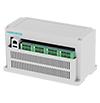
A useful system can coordinate generator output with battery charging and load demand rather than treating the diesel generator as an independent source. Our solution includes diesel-engine target-power control designed to prevent backflow, together with external current and voltage sampling for real-time load monitoring.
That functionality becomes especially valuable when renewable generation is introduced. The controller must decide how available solar energy, battery capacity, diesel generation, and load demand interact.
Research on hybrid microgrids likewise shows that component selection and operating strategy influence both capital investment and lifetime economics.
Switching behavior can also affect the quotation. Our solution supports seamless grid-connected/off-grid switching with critical loads remaining uninterrupted.
A quotation that includes these controls is therefore not directly comparable with one providing only basic DC/AC conversion.
A second major difference appears when the project needs capacity expansion. A PCS intended for one fixed installation has different requirements from equipment designed to operate as part of a modular parallel system.
Our diesel-storage solution supports up to 32 units in parallel operation. This type of capability can influence controller architecture, communication, protection coordination, synchronization, and commissioning requirements.
For hybrid renewable energy systems, scalability can therefore be part of the initial equipment value even if the first project phase does not use the maximum possible capacity. A modular architecture may provide a path for future expansion without replacing the original power-conversion platform.
Integration scope also affects price. A supplier may quote only the PCS hardware, while another may include generator interfaces, control equipment, communication interfaces, commissioning, and application engineering. These are not necessarily apples-to-apples offers.
Project location can add another layer. Remote island and mining applications may require different installation, commissioning, logistics, and service arrangements from a conventional commercial facility.
WidenEdge's published diesel-storage solution targets applications including off-grid islands, mining microgrids, emergency power, and post-disaster reconstruction.
When comparing a diesel battery (hybrid power system) quotation, we recommend building a technical comparison before looking at the final price.
Start with continuous and overload ratings. Confirm whether the stated power is continuous, temporary, or dependent on specific operating conditions. Then examine the supported load type, especially if the site has substantial unbalanced or motor loads.
Next, compare control functions. Ask whether diesel target-power control, backflow prevention, load monitoring, grid/off-grid switching, and coordinated battery operation are included or require additional equipment.
Communication and expansion should also be identified. If the project may add PCS units later, verify the parallel-operation architecture and maximum supported units rather than assuming that identical units can simply be connected together.
Finally, separate hardware price from system price. Engineering, commissioning, communication equipment, protection, generator integration, and service can all affect the total project cost.
The most expensive quotation is not automatically the best, and the cheapest is not automatically the most economical. For a diesel-battery hybrid application, we would compare the electrical architecture, transient capability, control functions, integration scope, and expansion path against the actual operating requirements.
That is why similar power ratings can produce very different prices. The kW number measures one dimension of the PCS; the real value lies in how reliably and intelligently the equipment manages the complete energy system.
For buyers evaluating hybrid projects, comparing technical scope before comparing price provides a much more meaningful basis for supplier selection.
Return