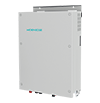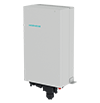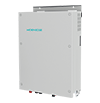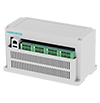
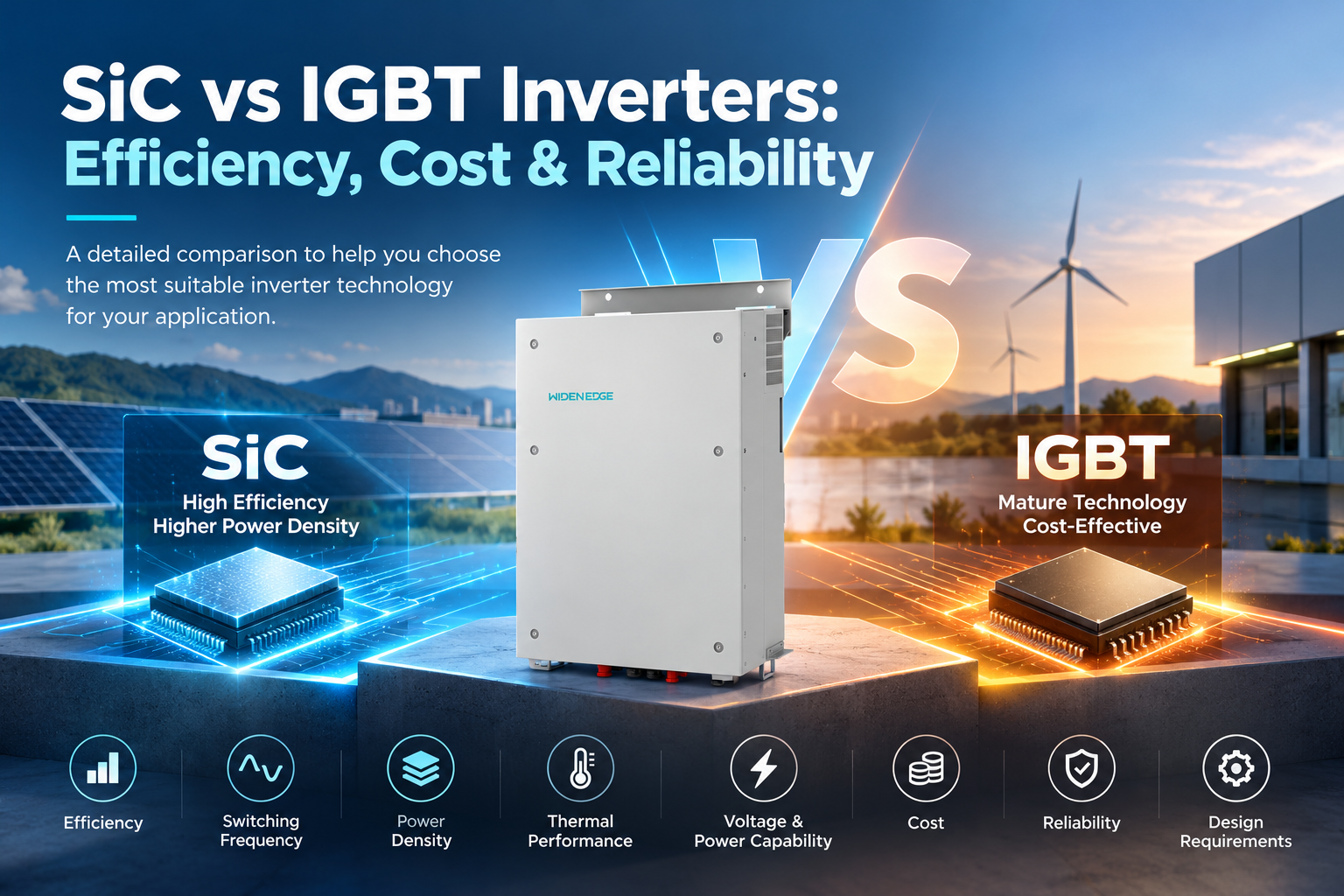
A silicon carbide inverter is a power converter that uses silicon carbide metal-oxide-semiconductor field-effect transistors as its main switching devices. It converts direct current into alternating current or performs the reverse conversion in a bidirectional system such as an energy storage PCS.
The switches control voltage, current, output frequency and power direction. Compared with silicon devices, silicon carbide switches can operate faster and usually produce lower switching losses.
As a result, a SiC inverter can achieve higher efficiency, higher power density and lower cooling demand. The trade-offs are higher device cost and stricter requirements for gate-driver design, circuit layout, insulation coordination and electromagnetic interference (EMI) control.
An IGBT inverter uses silicon insulated-gate bipolar transistors. It performs the same function described above, so the difference lies in switching behavior and system impact.
IGBT inverters offer lower cost, mature supply chains and field experience. However, compared with SiC devices, they operate at lower switching frequencies and produce higher switching losses. These losses can increase heat generation and cooling requirements, while lower switching frequencies can require larger filters.
The differences outlined above can be compared more clearly across the following eight factors.
Side-by-Side Comparison
|
Factor |
SiC inverter |
IGBT inverter |
|
Efficiency |
No tail current and no fixed on-state voltage drop; lower losses at high frequency and partial load |
Higher switching losses, but still practical at low or moderate frequency |
|
Switching frequency |
Commonly tens of kHz and above; allows smaller magnetics and filters |
Commonly below 20 kHz; requires larger passive components |
|
Power density |
Smaller cooling and passive components can support a more compact system |
Additional cooling and filtering may require more cabinet space |
|
Thermal performance |
Lower losses reduce heat generation and cooling demand |
Higher losses increase heat-removal and cooling requirements |
|
Voltage and power capability |
Well suited to 800 V and 1,500 V DC platforms that need high switching frequency |
Mature and cost-effective at 1,700 V device ratings and above, and at megawatt scale |
|
Cost |
Higher device and development cost, with possible energy and cooling savings |
Lower initial cost and easier platform reuse, but potentially higher operating losses |
|
Reliability |
Lower heat can reduce thermal stress, but fast switching requires careful protection |
Long field history and well-understood protection methods and failure modes |
|
Design requirements |
Stricter gate driving, low-inductance layout, insulation and EMI control |
Uses more established design, protection and validation methods |
Choose between SiC and IGBT by matching the inverter technology to your operating profile and project priorities. To make this choice, consider the following four questions:
SiC can justify its higher device cost in systems with long operating hours, limited cooling capacity or restricted installation space. Its switching losses can be 50% to 70% lower than those of conventional IGBTs, particularly at higher switching frequencies.
Higher-frequency operation can reduce the size of inductors, transformers and filter capacitors. Depending on the system design, this can reduce overall inverter size and weight by 30% to 50%.
SiC inverters can also achieve a one- to two-percentage-point efficiency improvement, with some designs exceeding 99% compared with around 98% for comparable IGBT designs. The additional cost is more likely to be recovered when these gains reduce energy losses, cooling equipment, enclosure size and installation costs.
IGBT remains practical when initial cost is important, and the required switching frequency is low. Its turn-off tail current increases switching losses as frequency rises, so IGBT systems commonly operate below 20 kHz.
Industrial motor drives and other high-power converters often operate between 2 and 16 kHz to control semiconductor losses and heat generation. At these frequencies, the system cannot fully use SiC’s high-frequency advantage to reduce filters and magnetic components. Therefore, IGBT may provide better value when compact size is not essential, and an established platform is already available.
System voltage can change the balance between SiC and IGBT. For 800 V or 1,500 V DC platforms, SiC is more suitable when the system requires higher switching frequency, lower losses, less cooling or a smaller enclosure. IGBT remains practical when switching frequency is low or moderate and initial cost is the main priority.
At device voltage ratings of 1,700 V and above, IGBT may still offer advantages in device cost and high-current capability. Therefore, the final choice should also consider converter topology, current requirements, cooling conditions and total system cost.
For energy storage systems, the main consideration is the cumulative energy lost during charging and discharging rather than peak efficiency alone. SiC is more suitable for frequent cycling and extended partial-load operation because its lower losses can preserve more usable energy. IGBT remains practical when operating hours or cycling frequency are limited and initial cost takes priority.
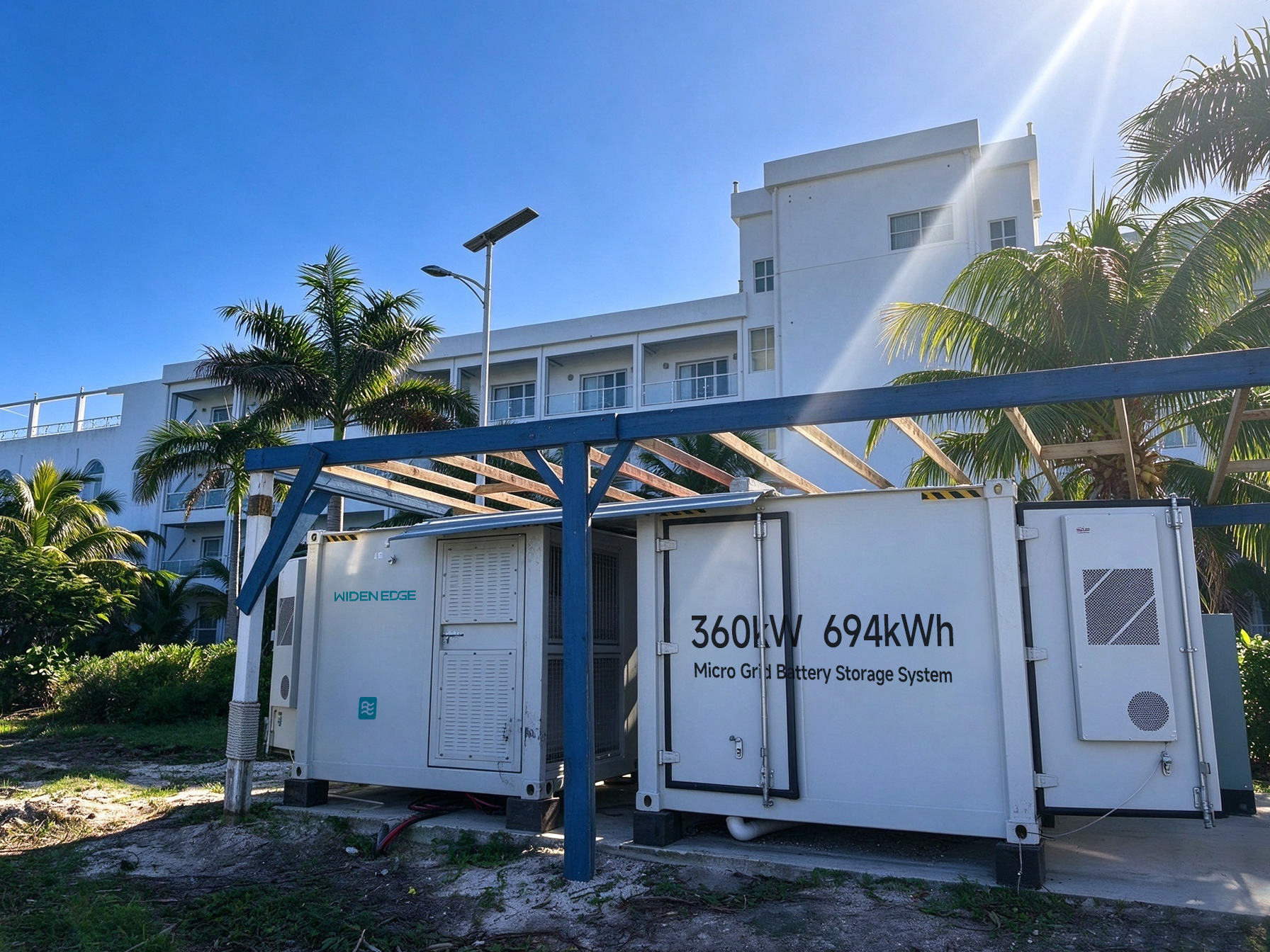
For microgrids, semiconductor technology and grid-support functions should be evaluated separately. SiC can improve power-conversion efficiency, but grid-forming operation, seamless mode switching, overload capacity, unbalanced-load support and diesel-generator coordination depend on the inverter’s control architecture. These functions must therefore be verified independently during selection.
Note: Actual performance and savings vary with device selection, inverter topology, voltage and power rating, switching frequency, load profile, cooling design, operating hours and environmental conditions. Final selection should be based on supplier data and project-specific requirements.
SiC and IGBT inverters are both used across energy, transportation and industrial power conversion. The applications below show where each technology is commonly deployed.
If you are selecting a SiC inverter for a weak-grid, off-grid or diesel-storage microgrid, the WidenEdge MGC-MK1 grid-forming PCS (inverter) is worth considering. Available in 150kW ratings, it combines SiC-based power conversion with control functions developed for microgrid operation.
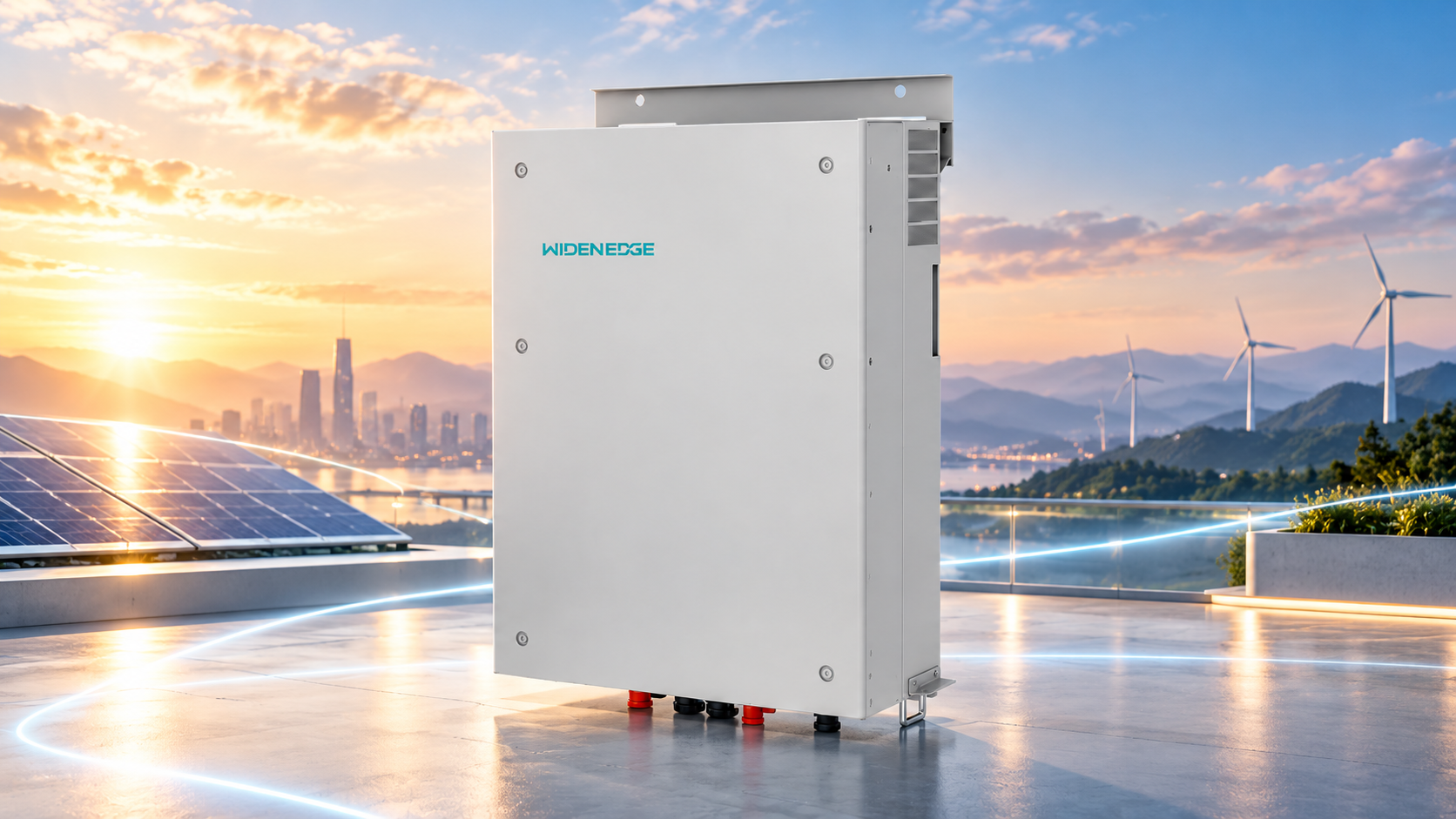
Its grid-forming control supports virtual synchronous generator (VSG) control, droop control and seamless switching between grid-following and grid-forming modes. It provides 1.5x for 3 seconds overload capability, rapid response to sudden load changes and 100% unbalanced-load support in off-grid mode.
For projects that combine energy storage with diesel generation, automatic diesel-generator control and key-parameter self-learning simplify system coordination. Its IP65 enclosure also supports operation in island and dusty environments. These capabilities make the MGC-MK1 relevant to microgrids that require flexible operating modes, demanding load support and diesel-generator coordination.
Yes. Lower semiconductor losses can reduce heat generation and cooling demand, although the actual benefit depends on the complete inverter design. WidenEdge applies SiC technology in its grid-forming power conversion systems for energy storage and microgrid applications.
Yes, but SiC itself does not provide grid-forming capability; the inverter’s control architecture is critical. WidenEdge’s MGC inverters support VSG and droop control, as well as seamless switching between grid-following and grid-forming modes.
No. SiC can reduce switching losses, but overall efficiency also depends on topology, thermal management, control, and operating conditions. WidenEdge takes a system-level approach by integrating SiC power conversion with grid-forming control for microgrid applications.
SiC inverters are the better fit when lower losses, higher power density and reduced cooling justify a higher initial cost, while IGBT remains practical for cost-sensitive, lower-frequency and established high-power systems.
For weak-grid, off-grid and diesel-storage microgrids, consider WidenEdge’s MGC-MK1 SiC inverter, which combines grid-forming control with overload and unbalanced-load support. Contact us to discuss your power rating, load profile and operating conditions.
[1]https://www.anernstore.com/blogs/diy-solar-guides/sic-vs-igbt-switching-ess-inverters
[2]https://sector-signals.net/en/themes/power-semiconductors/articles/igbt-still-matters-in-power-semiconductors
Return