
A highly unbalanced three-phase load means the three phases are drawing very different amounts of current. One phase might supply several single-phase machines while the other two carry much less demand.
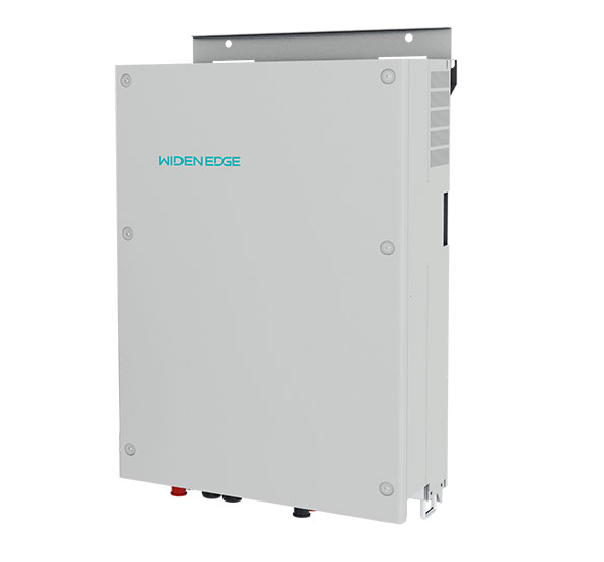
In an off-grid system, there is no utility network behind the inverter to absorb that imbalance. So how does a 150kW battery inverter keep the AC supply stable? The answer lies in its four-wire power architecture, independent phase regulation, and grid-forming control.
Consider a facility where one phase suddenly supplies a large group of single-phase loads. Total demand might remain within the inverter's overall power rating, yet the current distribution becomes uneven.
A conventional assumption of equal phase loading is no longer sufficient. Each phase needs to receive the amount of current demanded by its connected loads while the inverter continues maintaining the required AC voltage and frequency.
That is why the phrase “150kW” does not by itself describe unbalanced-load capability. The converter must manage power on each phase, not simply divide 150kW equally between three outputs.
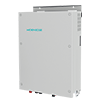
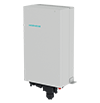
WidenEdge's MGC 100/150kW product documentation specifically states that the inverter supports independent phase regulation and 100% unbalanced load operation in off-grid mode. MGC 100/150kW product information
The first part of the mechanism is phase-level control. Rather than treating the three-phase output as three identical portions of one fixed power block, the control system regulates the electrical behavior of each phase according to its actual load.
Suppose phase A is heavily loaded while phases B and C are lightly loaded. The inverter responds by supplying more current through phase A and less through the other phases. The physical load remains unbalanced; the control system simply accommodates that condition.
This distinction is important in remote microgrids. A site does not need to rearrange every single-phase load merely because the loads are unevenly distributed. The converter can respond to the existing phase demand, provided that the phase-current and overall operating limits remain within its specified range.
Independent phase operation is closely connected with the AC output configuration. The MGC 100/150kW uses a three-phase four-wire transformerless architecture, according to the manufacturer's product information. That configuration provides a neutral path in addition to the three phase conductors.
The neutral is particularly relevant when single-phase loads are distributed unevenly. Their return currents do not need to be forced into a perfectly symmetrical three-phase arrangement.
From the inverter's perspective, this creates an electrical path through which the different phase currents can be supported while the converter maintains the local AC network. The architecture therefore forms part of the answer to how the inverter handles severe imbalance; control software alone is not the complete solution.
An off-grid battery inverter cannot depend on a utility grid to establish the voltage and frequency reference. It needs to contribute to creating that reference itself.
The MGC product documentation identifies grid-forming control, including virtual synchronous generator and droop-control functions. These controls allow the inverter to establish and regulate the local AC environment while supplying the connected loads.
Under an unbalanced condition, the control system must therefore perform two jobs simultaneously: accommodate different current demands on the three phases and keep the AC bus within its intended voltage and frequency behavior.
That is the central mechanism behind stable off-grid operation. The inverter does not eliminate the imbalance at the load. Instead, it controls its own output so that the imbalance can exist without automatically destabilizing the microgrid.
Steady unbalance is only half the challenge. Industrial and remote loads can change abruptly. A single-phase motor, heater, pump, or other equipment may switch on while the other phases remain lightly loaded.
The inverter must detect the resulting electrical change and adjust its output rapidly. According to the product information, the MGC 100/150kW includes automatic load-fluctuation control designed to respond to sudden load changes.
This response is especially important in islanded operation because there is no strong external source available to compensate for the disturbance. The battery and inverter form a major part of the available power source, so their control response directly affects the local bus.
Engineers should consequently examine actual phase-by-phase transient behavior rather than accepting a general statement that the inverter supports unbalanced loads.
The 150kW figure represents the inverter's overall power class, but it should not be interpreted as 150kW available independently on every phase.
Actual capability depends on the manufacturer's specified continuous output, phase-current limits, overload behavior, voltage conditions, and duration of the event. A project may have enough total power capacity while still exceeding a phase-specific limit.
For that reason, load analysis should calculate both total three-phase demand and the maximum demand on each individual phase. Short-duration starting currents should also be included where relevant.
This is where an off grid inverter needs to be evaluated against the real load profile rather than selected only from the site's total energy consumption.
The mechanism can now be summarized simply: the inverter accepts unequal phase demand, regulates the phases independently, uses its four-wire architecture to accommodate single-phase loading, and applies grid-forming controls to maintain the local AC reference.
A 150kW battery inverter therefore does not need to “balance” the physical loads before supplying them. Its role is to manage the electrical consequences of that imbalance within its specified operating limits.
For WidenEdge, this capability is particularly relevant to off-grid microgrids where mixed single-phase and three-phase loads are unavoidable. The MGC 100/150kW documentation states support for 100% unbalanced load operation in off-grid mode, which directly addresses the condition described in this article. WidenEdge MGC 100/150kW
When evaluating similar systems, we would therefore start with the actual phase-by-phase load profile. Total kW is only the first number. Maximum phase current, neutral current, transient demand, overload duration, and islanded voltage regulation determine whether the inverter can handle the site's real imbalance.
Ultimately, the value of a capable battery inverter is not that it makes an asymmetric load look balanced. It is that the converter can work with the imbalance while continuing to provide a stable local power supply. For highly uneven three-phase loads, that distinction is what separates a nominally suitable 150kW converter from one genuinely designed for demanding off-grid operation.
Return