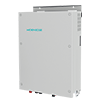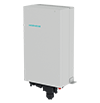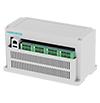
A PCS does not spend its entire operating life at rated power. Battery charging and discharging can occur at different power levels, while solar generation rises and falls throughout the day. That makes part-load efficiency an important engineering question: does SiC actually make a PCS more efficient when output power is below its rated value?
The short answer is yes, SiC can improve part-load efficiency by reducing semiconductor switching losses and, depending on device selection and operating conditions, conduction losses. However, the size of that improvement depends on the converter design. SiC reduces particular loss mechanisms; it does not remove the fixed losses of the complete PCS.
To understand the effect of SiC, we first need to separate PCS losses into different categories. Semiconductor losses include conduction and switching losses. Other losses come from magnetics, capacitors, cooling equipment, control electronics, sensing circuits, and other auxiliary components.
Output power has a strong influence on some of these losses. Conduction loss is related to current, while switching loss is associated with the energy dissipated during each switching transition and the switching frequency. Research on inverter loss modeling similarly treats conduction and switching as distinct components that vary with operating conditions.
At full load, current-related losses become significant. At reduced load, those losses generally decrease, but switching still occurs. Consequently, the relationship between output power and total loss is not simply proportional.
That is where SiC becomes relevant.
SiC MOSFETs can switch faster with lower switching losses than conventional silicon IGBT-based approaches in suitable designs. ROHM's technical analysis, for example, describes substantially lower switching losses for full-SiC modules compared with IGBT modules, with the difference becoming more significant as switching frequency increases.
The part-load connection is particularly important. Even when output current decreases, the power switches continue performing switching operations. If each transition dissipates less energy, the converter can reduce a loss component that does not fall as quickly as output power simply because the load has decreased.
Experimental work provides a useful illustration. ROHM reports that its tested SiC-based DC-DC converter showed improved efficiency under light loading, attributing the improvement in part to reduced switching losses.
For a 125kW commercial energy storage inverter, this means SiC can help flatten the efficiency penalty associated with operating below the nameplate rating. The exact result, however, depends on topology, switching frequency, device characteristics, gate-drive design, thermal conditions, and modulation strategy.
There is an important limit to the argument. A PCS has losses that SiC cannot eliminate.
Cooling fans, control boards, communication hardware, sensors, gate drivers, magnetic components, and other auxiliary circuits can consume power even when the converter is processing relatively little energy. As output power approaches a low operating point, these losses can represent a larger percentage of the input power.
That creates an efficiency curve with two competing effects. SiC can reduce semiconductor losses, but fixed and auxiliary losses become increasingly visible as load falls.
This explains why we should not interpret “SiC-based” as equivalent to “maximum efficiency at every load.” A well-engineered converter must optimize the complete loss budget. Device technology is one lever; topology, switching strategy, cooling architecture, and auxiliary consumption determine the final result.
The commercial value of improved part-load efficiency depends on how the PCS is actually used. A battery system performing peak shaving may repeatedly operate at moderate power instead of remaining near its maximum rating. Backup systems can spend long periods at low demand before a larger load appears.
C&I solar creates another variable operating profile. PV output changes with irradiance, while facility demand follows its own schedule. A storage PCS can therefore spend considerable operating time at intermediate power levels rather than at full capacity.
For that reason, a 125kW commercial energy storage inverter should be evaluated against the project's expected load distribution, not simply its maximum efficiency point. If most annual energy passes through the converter at 30% to 70% load, performance in that region deserves more attention than a peak figure achieved at rated output.
The same logic applies to C&I solar projects. A system designer should estimate how frequently the PCS operates at different power levels and then compare measured efficiency across those points.
The most useful question to a PCS supplier is not “Do you use SiC?” It is “Show me the measured efficiency curve and explain the losses behind it.”
Ask for efficiency data at several load points under clearly defined voltage, temperature, and operating conditions. Confirm whether auxiliary consumption is included. Without that information, two apparently similar efficiency figures may not represent the same measurement boundary.
Next, examine the technology behind the curve. SiC devices can reduce switching losses, but their benefit depends on how the complete power stage uses their characteristics. Gate-drive design, switching frequency, thermal management, magnetics, and control strategy all affect the final result.
We therefore treat semiconductor selection as part of converter architecture rather than a standalone specification. Our MGC platform is designed for energy-storage and microgrid operation, including applications requiring grid-forming control, fast response to load changes, and operation with unbalanced loads. Those operating requirements make the complete conversion architecture more important than a single component choice.
SiC can improve PCS part-load efficiency because it reduces switching losses and can also reduce conduction losses under appropriate operating conditions. The advantage becomes meaningful when those semiconductor losses form a significant portion of the converter's total loss at reduced output power.
Yet the benefit has a ceiling. At very light load, fixed and auxiliary consumption can dominate the remaining loss budget, so changing the semiconductor technology alone cannot guarantee exceptionally high efficiency.
The correct assessment for purchasers looking to compare 125kW commercial energy storage inverters is, hence, a comprehensive efficiency curve that is correlated with the project's functional profile. Since fluctuating generation inherently produces a wide variety of PCS loading circumstances, C&I solar projects should be treated similarly.
Instead of assessing SiC by its technical designation, WidenEdge suggests looking at the demonstrable reduction in overall conversion losses across those practical operating points. That approach answers the real engineering question: how much energy does the PCS save during the hours when it is not operating at full power?
Return