Grid-forming PCS must do more than transfer battery power to an AC bus. It can establish voltage and frequency, respond to changing loads, and coordinate with other power sources when a strong utility reference is unavailable. That makes the switching stage particularly important.
Silicon carbide has attracted attention because its electrical and thermal properties can support faster switching, lower switching losses, and higher power density than conventional silicon devices in suitable converter designs.
A grid-forming inverter actively regulates the AC waveform instead of simply synchronizing to an established grid. That places greater demands on the converter's control loop, switching devices, filters, thermal system, and overall power stage.
For manufacturers, the semiconductor choice therefore becomes part of a broader design decision. A silicon carbide inverter can offer useful electrical characteristics, but those characteristics only create value when the control architecture and power stage are designed to exploit them.
The distinction matters because grid-forming performance is not created by the semiconductor alone. Voltage regulation, frequency control, virtual synchronous-machine behavior, droop characteristics, protection, and energy-management functions remain system-level engineering tasks.
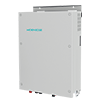
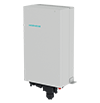
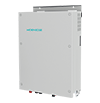
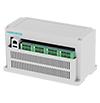
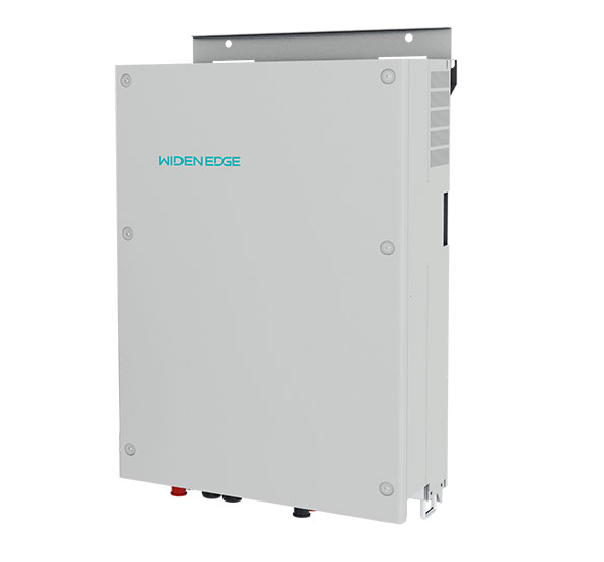
The MGC product from WidenEdge, for example, uses grid-forming control with VSG and droop control and is designed for switching between grid-following and grid-forming modes.
One reason manufacturers consider SiC is its ability to operate at higher switching frequencies than many conventional silicon power devices. SiC's wide bandgap, high breakdown field, and favorable thermal characteristics support high-speed power conversion with reduced switching losses under appropriate conditions.
That matters inside a PCS because switching frequency influences the design of filters, magnetic components, and waveform control. Higher-frequency operation can allow smaller passive components, although the final result depends on topology, modulation strategy, voltage level, cooling, EMI constraints, and switching losses.
Research on SiC-based distributed-energy converters has also identified improvements in efficiency and power density as important application benefits.
We therefore view switching speed as an engineering tool rather than a marketing number. A manufacturer has to balance faster switching against electromagnetic interference, voltage overshoot, gate-drive behavior, and thermal stress.
Heat is another reason SiC is attractive for power-conversion equipment. Its material properties provide higher thermal conductivity and allow power devices to tolerate higher junction temperatures than conventional silicon devices, subject to the limits of the actual device and package.
For a commercial energy storage inverter, thermal behavior affects more than the semiconductor itself. Heat sinks, fans, enclosure dimensions, internal spacing, and operating derating all influence the final product.
A 125kW commercial energy storage inverter may need to operate through changing load conditions rather than a constant laboratory duty point. That makes the relationship between electrical losses, cooling capacity, and enclosure design important when evaluating a PCS architecture.
Higher-frequency switching can also influence the size of passive components. Magnetic components and filtering requirements are closely connected to switching behavior, so a converter designed around faster devices may have opportunities for greater power density.
For grid-forming PCS, this can be valuable where installation space is limited. Smaller power stages can simplify equipment packaging and potentially reduce the physical footprint of a battery energy storage system.
However, we would not equate higher frequency with automatically better performance. Faster switching can increase EMI, current overshoot, and other design challenges if layout, gate drive, parasitic inductance, and filtering are not carefully controlled.
The material advantage is only one layer of the design. A silicon carbide inverter still needs an appropriate topology, control strategy, protection scheme, thermal architecture, and software implementation.
This distinction is especially important for buyers comparing PCS suppliers. A product should not be selected simply because its semiconductor technology is described as advanced. We would instead ask how the manufacturer translates that technology into measurable converter behavior.
Relevant questions include how the PCS manages rapid load changes, how its filters are designed, how thermal limits affect continuous operation, and how the control system responds during weak-grid or islanded conditions.
A 125kW commercial energy storage inverter can benefit from compact power conversion when the site has demanding space, thermal, or operating requirements. Yet the appropriate semiconductor technology still depends on the complete electrical architecture.
For an integrator, the better comparison is therefore not “Si versus SiC.” It is whether the proposed PCS delivers the required combination of efficiency, thermal behavior, power density, control performance, and maintainability for the application.
WidenEdge's MGC platform illustrates this system-level approach by combining energy-storage inversion with grid-forming control, high overload capability, unbalanced-load support, rapid response to load changes, and diesel-generator control functions.
Grid-forming PCS manufacturers use silicon carbide because its material properties can give designers more room to optimize the power stage. Higher switching capability, reduced switching losses, thermal headroom, and potential power-density gains are particularly relevant when a converter must respond precisely while remaining compact.
Still, SiC should be viewed as an enabling technology, not the definition of a high-performance PCS. WidenEdge considers the semiconductor, power topology, thermal design, and grid-forming controls as interconnected parts of the converter.
That leads to a more practical takeaway for procurement: look beyond the device material when evaluating a silicon carbide inverter, and instead ask what measurable system-level improvement it delivers.
The strongest design is the one that turns SiC's electrical and thermal advantages into reliable grid-forming behavior under the actual operating conditions of the energy-storage project.
Return