The most challenging engineering point for a microgrid occurs during the transition from operating independently to operating alongside the utility grid. While the electrical reference is changed, the local system must continue to serve important loads in the event that the utility supply is lost. Uncontrolled transitions pose a threat to the microgrid because they can cause voltage and frequency problems to spread.
That is why seamless switching matters. A capable PCS does more than open or close a breaker. It must control the electrical system before, during, and after the transition so that the microgrid can move from dependence on the utility to autonomous operation without unnecessary disruption.
Grid-connected and off-grid operation each have established control objectives. The transition is harder because the system's electrical conditions are changing while loads and power sources remain active.
Under normal grid-connected operation, the utility effectively provides the voltage and frequency reference. Once the point of common coupling is opened, that reference is no longer available. The microgrid must immediately establish and maintain its own operating conditions.
Research on microgrid transitions has shown that changing between interconnected and islanded operation can produce transient overcurrents or power oscillations if the transition is not properly controlled.
The objective, therefore, is not simply to make the breaker operate quickly. The objective is to keep the electrical variables sufficiently controlled throughout the change.
This is where a grid-forming PCS becomes particularly important. Rather than merely following an external voltage waveform, grid-forming control can establish voltage and frequency behavior for the local network during islanded operation.
A successful transition requires the PCS to move from supporting power exchange with the utility to actively maintaining the local electrical reference. Control strategies studied for seamless microgrid operation commonly address voltage, frequency, active power, reactive power, and synchronization as interconnected problems.
The distinction is important for a 100kW grid-forming inverter. Its value is not defined only by its 100kW rating. The more important question is whether its control architecture can maintain stable operation when the utility reference disappears.
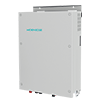
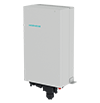
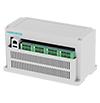
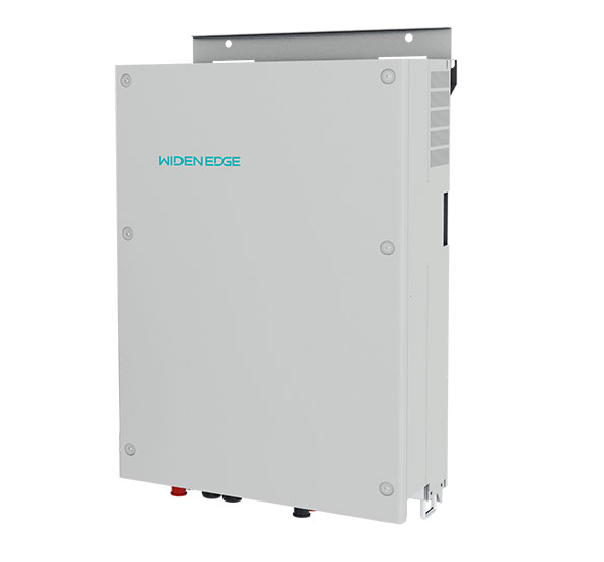
Our MGC MK3 uses grid-forming control with VSG and droop control and is designed to support switching between grid-following and grid-forming modes. The product is specifically positioned for microgrid operation where grid-connected and off-grid states may both be required.
A fast electrical transfer does not automatically mean a stable transfer. Once the utility is disconnected, the PCS must respond to the power imbalance created between local generation, storage, and demand.
Suppose a facility is consuming power when the grid fails. The battery system may need to change its power contribution rapidly while the PCS establishes the local voltage and frequency reference. A sudden change in load can also create a temporary mismatch that the control system must manage.
This becomes more complicated when loads are unbalanced. Commercial and industrial facilities rarely behave like ideal balanced laboratory loads. Motors, power electronics, single-phase equipment, and other loads can create phase-specific demands.
Our MGC design supports 100% unbalanced loads in off-grid operation and includes automatic load-fluctuation control and a built-in synchronization interface. These functions address the practical electrical conditions that can appear during autonomous operation rather than treating the transition as a simple breaker event.
The return to utility operation deserves the same attention as grid loss. A microgrid cannot simply reconnect whenever the utility voltage returns. The local and utility-side electrical conditions must be appropriately aligned before reconnection.
Voltage magnitude, frequency, and phase relationship all matter. Research on seamless microgrid transfer identifies pre-synchronization as an important part of reconnecting the microgrid to the utility without creating severe transients.
Recent work on grid-forming inverters also emphasizes maintaining consistent operating points during transitions. Voltage, frequency, active power, reactive power, and phase angle all influence the quality of the transfer.
This makes synchronization capability a core PCS function. The system needs to know when reconnection conditions are suitable and coordinate the transition rather than treating the utility return as an independent switching command.
A seamless transition depends on several functions working together. First, the PCS needs an operating strategy for detecting or responding to the change in grid condition. Second, it must establish appropriate voltage and frequency behavior once islanded. Third, power sharing between the battery and other local sources must remain coordinated.
The same control architecture must also handle the return to grid-connected operation. Synchronization, mode management, protection, and power-flow control cannot be designed as unrelated functions.
That system-level coordination becomes especially relevant in hybrid microgrids. Our MGC platform includes diesel-generator self-learning and automatic generator control, allowing storage, generation, and loads to participate in a coordinated microgrid architecture. The product page also documents projects combining solar, diesel, and storage where grid outages require continued local supply.
For a project using a 100kW grid-forming inverter, the correct evaluation is therefore broader than checking whether the inverter can form a voltage. Engineers should examine how the PCS manages the entire transition sequence and interacts with the rest of the microgrid.
The fundamental benefit is continuity of electrical service. A microgrid becomes significantly more useful when it can move between utility-connected and autonomous operation without forcing every downstream system to experience a major electrical disturbance.
That matters particularly for facilities where an interruption can affect production, communications, refrigeration, data processing, or other critical processes. The value comes not simply from having battery storage, but from controlling how that stored energy becomes the electrical reference when the utility is unavailable.
An off grid switch therefore should not be viewed as an isolated hardware component. The physical switching device may disconnect the utility, but the PCS control system determines what happens electrically around that event.
We design around this distinction. A microgrid PCS must coordinate power conversion, grid-forming behavior, load response, synchronization, and other distributed resources so that the operating state changes as a controlled electrical process.
Seamless grid-connected/off-grid switching matters because a microgrid must remain electrically stable while its source of voltage and frequency reference changes. A breaker can disconnect the utility, but only coordinated PCS controls can manage the resulting transition.
Therefore, project developers and EPC teams should not limit themselves to just checking if a product supports islanding while doing practical evaluations. Specifically, you want to know how it sets up the islanded reference, deals with imbalanced demand and load variations, coordinates with other generators, and synchronises before reconnecting.
That is the difference between a microgrid that merely has an off-grid mode and one that can transition between operating states as a controlled power system. WidenEdge treats seamless switching as part of the PCS's core control function because reliable microgrid operation depends on what happens during the transition—not just what happens before and after it.
Return