Traditional off-grid power architectures rely heavily on diesel generators to provide foundational rotating inertia and stable voltage references. Eliminating fossil fuel generators demands an advanced power conversion mechanism capable of establishing an autonomous network reference from scratch.
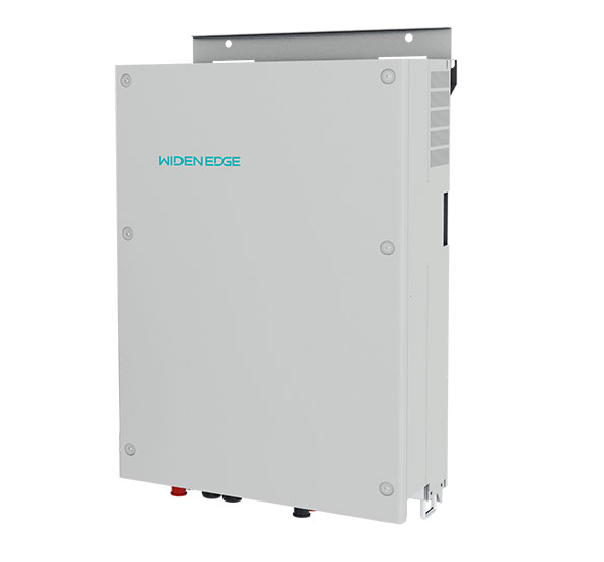
System designers achieve this by deploying intelligent power electronics that synthesize stable alternating current waveforms entirely from stored energy reserves. Understanding this operational shift requires examining how modern electronics replace heavy mechanical machinery in remote sites.
Decentralized networks operating without spinning reserves must rely entirely on software-defined electrical parameters to maintain system integrity. Without a physical diesel engine, the power conversion system itself becomes the primary heartbeat of the entire microgrid architecture. This transformation shifts the engineering paradigm from passive current injection to active voltage-source generation across all connected nodes.
Conventional grids depend on the massive physical rotors of synchronous generators to maintain frequency stability during sudden load shifts. Without these rotating machines, an isolated microgrid faces immediate voltage collapse unless an alternative electronic reference takes charge.
Advanced power conversion systems resolve this operational challenge by operating as controlled voltage sources rather than passive current injectors. Instead of following an external waveform, the hardware actively generates its own sinusoidal voltage and frequency profile under varying loads.
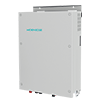
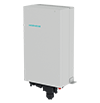
For smaller commercial or industrial microgrids, deploying a standardized 100kW grid-forming inverter provides sufficient local capacity to anchor an entire isolated network. This device calculates real-time modulation signals internally, bypassing the need for phase-locked loops or external synchronization signals.
Local loads simply lock onto the clean voltage vector established by the semiconductor switches. Consequently, facilities can achieve total energy independence without burning fossil fuels or maintaining spinning mechanical reserves.
Network stability in these configurations relies on continuous internal calculations rather than physical momentum stored in heavy metal rotors. The control circuitry updates voltage vectors thousands of times per second to neutralize incoming load disturbances instantly. This digital agility allows isolated systems to maintain tight frequency control even when solar irradiance fluctuates unpredictably throughout the day across rural terrain.
Replicating the behavior of a mechanical generator using static switches requires sophisticated internal software architecture and fast digital signal processing. Engineers implement specialized algorithms that mimic the physical droop characteristics and governor responses of traditional machinery.
Specifically, a virtual synchronous generator inverter calculates active power frequency droop and reactive power voltage droop in real time. This software framework ensures that the system shares load proportionally when multiple power converters operate in parallel.
When an industrial motor starts up, it draws a massive inrush current that causes severe voltage dips in standard networks. A voltage-source converter responds instantaneously by adjusting its internal voltage angle and magnitude to support the sudden load demand without external cues.
This rapid electronic reaction eliminates the multi-second delay characteristic of diesel engine governor responses. The system stabilizes network parameters within milliseconds, preventing protective relay trips across connected industrial equipment.
At WidenEdge, our engineering teams focus heavily on refining these algorithmic control loops to maximize stability in entirely fossil-free deployments. By processing control variables at high switching frequencies, our hardware reacts to load fluctuations faster than any mechanical engine ever could. This precision allows microgrid operators to run high-penetration solar and storage networks with complete confidence.
Advanced droop equations programmed into the internal controller simulate damping coefficients to suppress low-frequency power oscillations effectively. This software-driven emulation bridges the gap between traditional heavy machinery and modern solid-state power conversion equipment seamlessly. Operators no longer need mechanical flywheels to absorb minor frequency transients within isolated microgrid environments.
Operating without a diesel backup means the energy storage medium must absorb every transient fluctuation and peak demand surge instantly. Battery energy storage systems act as the primary energy reservoir, supplying or absorbing active power according to real-time microgrid requirements.
The power conversion system continuously monitors the state of charge and modulates DC-to-AC conversion rates to maintain equilibrium. When deploying a virtual synchronous generator inverter within hybrid configurations, system integrators gain superior control over transient energy exchanges.
Managing these rapid power shifts without mechanical damping requires meticulous thermal and electrical design within the hardware enclosure. Silicon carbide power modules handle high-frequency thermal stress far better than legacy silicon semiconductors during deep cycling events.
Engineers at WidenEdge ensure that every conversion platform maintains high efficiency across partial and full load profiles alike. This hardware resilience guarantees continuous power delivery even when isolated microgrids experience erratic load behaviors.
Furthermore, fault management during downstream short circuits requires specialized firmware limits to protect semiconductor switches from overcurrent damage. Because the system acts as a stiff voltage source, a fault can draw dangerous current spikes if left unchecked.
Advanced control routines dynamically inject virtual impedance during faults to limit current magnitude while preserving stability. Once the fault clears, the system automatically restores normal voltage waveforms without requiring manual resets or generator restarts.
Ultimately, achieving complete independence from fossil fuel generators proves that modern power electronics can fully replace traditional spinning reserves. Deploying a robust 100kW grid-forming inverter allows remote sites to operate cleanly and reliably under any environmental condition. Through continuous innovation, WidenEdge delivers advanced power conversion systems that make fossil-free microgrids a practical reality for global commercial partners.
Return