Starting an induction motor is one of the more demanding events for an inverter-based microgrid. The motor may require substantially more current during acceleration than it does after reaching normal speed, creating voltage and frequency disturbances that a small islanded source cannot simply absorb.
Research on grid-forming microgrids confirms that induction-motor starting can challenge inverter control loops because of high inrush current and associated voltage and frequency deviations.
A battery PCS can handle this event by acting as a controlled voltage source rather than waiting for a strong utility grid to provide the starting current. The important question is not whether the battery contains enough stored energy in general, but whether the PCS, controls, and microgrid architecture can deliver the required instantaneous electrical response.
An induction motor behaves very differently at startup and during normal operation. Before the rotor accelerates, the motor's electrical conditions can produce a large current demand. Large induction motors can draw several times their rated current during starting, and weak supplies may experience significant voltage dips as a result.
That demand creates a particular problem for an islanded inverter. A utility grid normally has substantial short-circuit strength and generation capacity behind the motor.
A battery-based microgrid has a finite inverter current capability. If the PCS reaches its current limit too early, the motor may fail to accelerate, while the resulting voltage disturbance can also affect other connected loads.
Consequently, a 60kW off-grid PV inverter must be evaluated by more than its continuous active-power rating when motors are part of the load profile. Starting capability depends on transient current, control behavior, available battery power, and the characteristics of the motor and driven equipment.
The first requirement is to establish a stable AC voltage and frequency reference. In an islanded system, there is no utility source defining those quantities. A grid-forming PCS therefore has to create and regulate the electrical conditions seen by the motor.
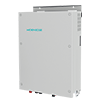
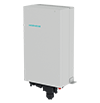
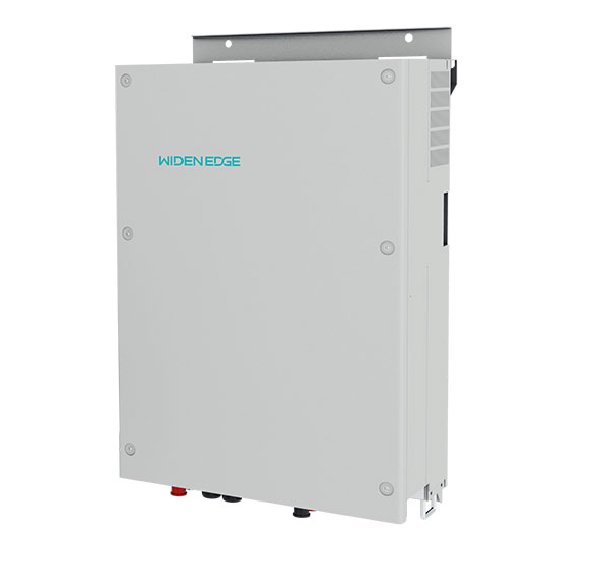
Our MGC 45/60kW platform uses grid-forming control with VSG and droop control and supports switching between grid-following and grid-forming modes. Its product information also specifies off-grid operation with support for 100% single-phase unbalanced loads.
During motor connection, the PCS responds to the sudden change in load while maintaining its voltage-forming function. The objective is not to hold every electrical variable perfectly constant regardless of the load, but to keep the system within an operating envelope in which the motor can develop sufficient torque and continue accelerating.
That is why island mode in microgrid design must consider motor-start events explicitly. A steady-state load calculation cannot demonstrate that an inverter will successfully energize a large induction motor.
The battery provides an important advantage because its stored energy can be converted through the PCS into short-duration electrical power when the motor demands it. Yet the battery's energy capacity alone does not determine starting performance.
The inverter's semiconductor devices, current limits, control strategy, DC-side voltage, and thermal design determine how much instantaneous electrical output can actually be delivered.
EPRI's grid-forming inverter material demonstrates the issue clearly: when inverter current is capped at its rated level, a substantial induction-motor load may require more temporary active and reactive power than the inverter can provide, causing starting failure.
Our product documentation describes the MGC 45/60kW as having high overload capability, alongside a wide battery-voltage range and dual DC interfaces for simultaneous PV and battery connection.
For a 60kW off-grid PV inverter, this distinction is critical. If PV and battery resources share the DC-side architecture, the battery can support the transient demand while PV generation continues contributing available power. The actual starting envelope, however, must still be confirmed against the PCS specifications and motor characteristics.
Voltage support is central to motor acceleration. If the motor causes excessive voltage depression, its ability to develop accelerating torque can deteriorate, potentially extending the starting period or causing the motor to stall.
A grid-forming PCS manages the islanded AC reference while responding to changes in active and reactive power. Droop-based behavior can coordinate power sharing in systems with multiple sources, while VSG-based control can provide a controlled response intended to resemble aspects of synchronous-source behavior.
The practical objective of island mode in microgrid operation is therefore broader than simply disconnecting from the utility. The PCS must establish a stable electrical island capable of accepting dynamic loads.
Motor starting should also be coordinated. EPRI notes that starting multiple induction motors simultaneously can exceed the combined current capability of the inverters and recommends coordinating motor startup during black-start sequences.
Successful motor starting begins with the motor, not the inverter datasheet alone. Engineers should identify motor rated power, starting method, starting current, acceleration time, driven-load torque, and whether multiple motors can start simultaneously.
Next, the PCS should be checked for continuous power, temporary overload capability, current limits, voltage regulation, and grid-forming behavior. The battery should also have sufficient power capability to support the event without violating its operating limits.
Load sequencing can then reduce the worst-case event. Rather than connecting every large motor simultaneously, the control system can prioritize critical loads and start motors sequentially where the application permits.
Starting methods such as soft starters or variable-frequency drives can further reduce the electrical stress compared with direct-on-line starting, although their suitability depends on the motor and application.
We would also validate the complete system through simulation or commissioning tests where the motor-start event is significant. A 60kW off-grid PV inverter may perform well with conventional loads but require a different operating strategy when a high-inertia motor becomes part of the islanded load.
The central principle is simple: a battery PCS starts an induction motor by creating the islanded voltage and frequency reference, delivering the required transient electrical power within its current and overload limits, and maintaining stable conditions while the motor accelerates.
At WidenEdge, we treat motor starting as a system-level event rather than a standalone inverter specification. For an off-grid microgrid, that means matching the PCS, battery, motor, starting method, and load sequence so the inverter's grid-forming capability is used within a clearly defined operating envelope.
Return