A three-phase microgrid can look balanced on the system diagram while its actual loads are anything but balanced. One phase may supply substantially more power than the others because of single-phase equipment, residential loads, pumps, lighting, or other unevenly distributed demand. For a PCS operating in islanded conditions, that imbalance is not simply a downstream load issue. It directly affects current distribution, control performance, thermal stress, and the stability of the local AC bus.
A balanced three-phase system ideally distributes comparable currents across all three phases. Heavy single-phase demand changes that relationship. If one phase carries significantly more current, the three-phase voltage and current waveforms no longer behave as they would under a symmetrical load.
The resulting condition can be described using symmetrical components, where an unbalanced system contains positive-, negative-, and potentially zero-sequence components. Negative-sequence current is particularly relevant to power-conversion equipment because it represents a departure from the balanced rotating field assumed by many conventional three-phase control strategies.
For a microgrid PCS, the practical question is not simply whether imbalance exists. Engineers need to determine how much imbalance occurs, how frequently it occurs, and whether it appears during normal operation, startup, or sudden load changes.
Unequal phase currents change how the converter's semiconductor switches, inductive components, filters, and thermal system are utilized. One phase can approach its current limit while the total three-phase power still appears to be within the nominal system rating.
That distinction is easy to miss during capacity selection. A PCS rated for a particular total output does not automatically mean every possible phase distribution can be delivered continuously at that total power. Phase-current limits and the manufacturer's stated unbalanced-load capability therefore deserve separate attention.
Control behavior matters as well. A PCS must measure the individual phase conditions and regulate the AC output without allowing the most heavily loaded phase to destabilize the bus or trigger protective limits unnecessarily.
Utility-connected systems can benefit from the grid's substantial short-circuit capacity and voltage stiffness. An islanded microgrid has much less external electrical strength, so the PCS is more directly responsible for establishing and maintaining the AC waveform.
That makes a 60kW off-grid PV inverter particularly sensitive to the relationship between load profile and control strategy. A sudden increase on one phase can produce a larger voltage disturbance than the same change might create on a strong utility connection.
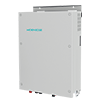
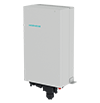
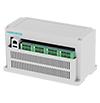
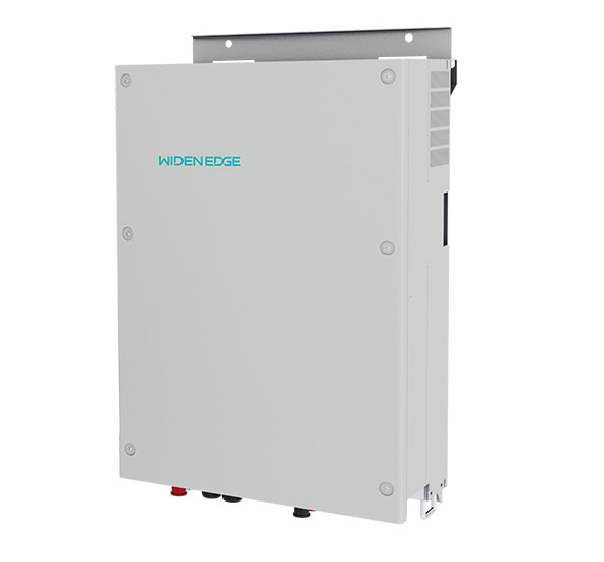
Our MGC platform is designed for off-grid microgrid operation and supports 100% single-phase unbalanced loads. Its architecture is therefore aimed at situations where three-phase infrastructure must supply substantially unequal phase demand rather than assuming a symmetrical load.
A common design assumption is that a three-phase inverter will primarily serve balanced three-phase loads. That assumption becomes problematic when the actual site contains many single-phase circuits.
Imagine a facility where most critical equipment is connected to one phase while the remaining phases carry relatively modest demand. Total facility consumption might remain below the PCS's apparent power rating, yet the heavily loaded phase could become the limiting factor.
Another issue is dynamic behavior. Large single-phase motors or other loads can change their current demand rapidly. If the PCS control system does not respond appropriately, the local voltage can move outside the desired operating range even though average system power appears manageable.
Handling severe phase imbalance requires more than increasing the nominal kW rating. The converter needs control logic capable of regulating each phase under asymmetric conditions while keeping the overall AC system stable.
A grid-forming PCS is particularly relevant in islanded microgrids because it actively establishes voltage and frequency rather than depending entirely on an external grid reference. WidenEdge's MGC platform uses grid-forming control with virtual synchronous generator (VSG) and droop-control functions, alongside grid-following and grid-forming operating modes. WidenEdge MGC 60kW product information
The DC side also matters. PV generation and battery storage may fluctuate independently of the load. Coordinating these power sources while managing unequal AC-phase demand requires sufficient control bandwidth, energy buffering, and correctly defined current limits.
We recommend starting with the actual phase-load data rather than the facility's three-phase nameplate. Record maximum current and power on each phase, identify the largest single-phase unbalanced loads, and examine startup or transient events separately from steady-state consumption.
Next, compare those measurements with the PCS's published phase-current and unbalanced-load capabilities. A specification stating support for unbalanced loads is useful, but project engineers should also establish the conditions under which that capability applies.
Thermal behavior deserves equal attention. Continuous imbalance can cause one portion of the power stage to operate closer to its thermal limit than the others. Ambient temperature, enclosure design, installation clearance, and expected duty cycle should therefore be evaluated together.
Finally, examine the operating sequence. A site may be balanced most of the day but become heavily asymmetric during an outage, precisely when the microgrid transitions into islanded operation. That scenario should be included in commissioning and system-level testing.
Heavy three-phase load imbalance becomes a PCS problem when unequal phase demand pushes individual converter phases, controls, or thermal components toward their limits. The total kW figure alone cannot reveal that risk.
For an off-grid microgrid, the safer approach is to design around the worst realistic phase distribution and its transient behavior. We would prioritize measured phase currents, single-phase load characteristics, PCS control mode, and stated unbalanced-load capability before finalizing the converter rating.
A 60kW system can therefore be suitable for a challenging load profile only when its architecture explicitly supports that operating condition. The relevant question is not simply “How much power can the PCS provide?” but “How can it distribute and regulate that power when the three phases demand very different amounts?”
That distinction is central to reliable microgrid design. WidenEdge approaches unbalanced-load projects from the phase level upward, matching converter capability to the electrical behavior that the microgrid will actually experience.
Return