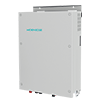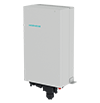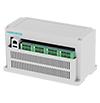
In our multi-unit microgrid projects, the moment of islanding is the real test of system design. We have seen centralized control architectures fail precisely when they are needed most—during an unplanned utility outage. That is why we design our modular inverter systems to share load automatically without a master controller, using decentralized droop control that mimics traditional synchronous generators. Here is how we make that work in practice.
Operating multiple power units simultaneously without a centralized master controller introduces complex synchronization hurdles requiring decentralized intelligence. Engineers implement specialized droop characteristics into converter firmware to mimic traditional synchronous generators.
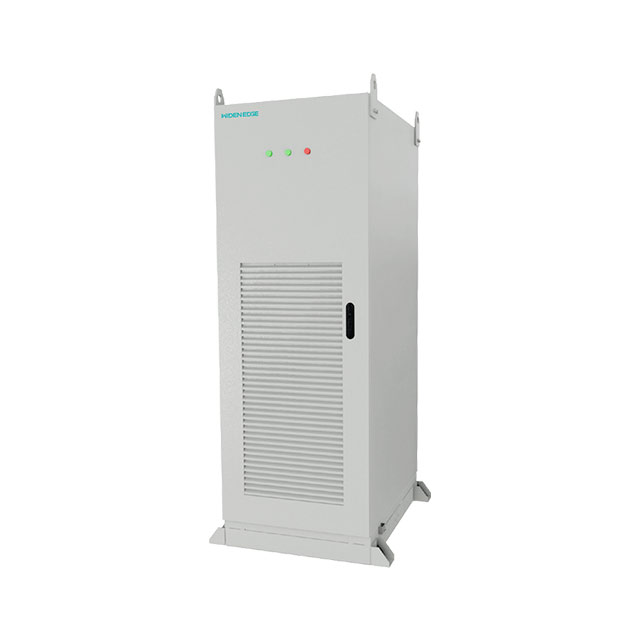
Decentralized control algorithms empower each power module to calculate its share of total electrical demand locally, removing single points of failure. Industrial sites deploying a high-capacity 600kW energy storage inverter rely heavily on this autonomous distribution logic to survive sudden grid loss events and maintain continuous power delivery.
Transitioning smoothly from grid-tied states to standalone microgrid operation requires instantaneous adjustment of internal control loops without causing destructive voltage transients. Eliminating communication dependencies ensures system survivability remains intact.
Establishing reliable multi-unit operation relies on precise phase-angle locking and voltage regulation frameworks embedded directly within the local control architecture. Microgrid operators demand robust hardware solutions that handle abrupt islanding transitions gracefully under fluctuating load profiles.
Ensuring seamless coordination across scattered assets prevents catastrophic system collapses during unexpected utility disconnections. Technical teams evaluate decentralized droop configurations thoroughly before deploying power electronics in remote facilities.
Balancing active power across parallel conversion hardware requires a precise relationship between output power fluctuations and system frequency adjustments. Generating active power causes the internal virtual frequency of a converter to drop slightly below nominal baseline values during heavy load demands.
Proportional droop curves ensure units carrying heavier electrical loads automatically reduce their operating frequency, prompting neighboring devices to pick up slack. Adjusting local setpoints allows multiple conversion blocks to share active demand proportionally.
System controllers continuously monitor real-time frequency deviations to modulate semiconductor switching angles without relying on vulnerable external data cables. Advanced installations utilizing a robust modular inverter architecture benefit greatly from decentralized active power sharing because communication delays are entirely eliminated.
Distributing active load effectively prevents thermal overloading on individual power electronics stacks, ensuring balanced wear across parallel conversion channels. Calibrating droop slopes accurately guarantees proper power contributions.
Maintaining stable frequency parameters during heavy load steps demonstrates the superiority of droop-controlled generation assets over traditional master-slave setups. Field technicians configure response parameters carefully during initial site commissioning to optimize dynamic load-sharing performance.
Power system planners verify active power responses through rigorous hardware testing protocols prior to commercial site launch. Reliable frequency management safeguards critical loads against severe microgrid frequency excursions across all connected nodes.
Controlling reactive power distribution presents unique physical challenges because inductive grid impedances dictate voltage drop profiles across microgrid distribution lines. Regulating reactive power output depends on adjusting the amplitude of the terminal voltage vector produced by each power conversion block.
Droop equations tie reactive current injections directly to local voltage magnitude variations, forcing units to absorb or supply reactive power autonomously. Lowering terminal voltage prompts specific power modules to draw more reactive load.
Balancing reactive currents prevents localized overvoltages or severe voltage sags that could otherwise trip sensitive industrial machinery during transient load shifts. Engineering teams at WidenEdge prioritize ultra-fast voltage regulation loops within our control firmware to guarantee seamless reactive load sharing among parallel nodes.
Distributing reactive burdens evenly among parallel converters stops circulating currents from flowing wastefully between adjacent AC output terminals. Suppressing circulating energy protects internal magnetic components from unnecessary thermal stress.
Optimizing reactive power compensation enhances overall power factor performance across decentralized microgrids lacking external grid support. Facility operators achieve superior voltage stability by deploying advanced conversion hardware configured with precise reactive droop algorithms.
Reactive power coordination eliminates voltage hunting behavior among neighboring power conversion units operating in close physical proximity. Maintaining stable terminal voltages ensures consistent equipment performance across diverse industrial and remote microgrid environments.
Scaling up isolated microgrids with a high-performance modular inverter setup allows multiple conversion units to operate in tight synchronization without central supervisory links. Hardware design must account for minor component tolerances and impedance variations that could trigger unequal current sharing among parallel branches during transient states.
Balancing internal thermal loads across submodules ensures that a rugged 600kW energy storage inverter avoids premature degradation under heavy islanded operation. Robust enclosure designs safeguard sensitive semiconductors.
Synchronizing multiple conversion devices successfully requires meticulous harmonization of software control loops alongside exceptionally robust hardware durability standards. Industrial microgrids demand uninterrupted power delivery capabilities that only thoroughly tested parallel topologies can consistently provide across harsh environments.
Managing multi-unit arrays effectively involves continuous self-diagnosis checks and real-time parameter tuning to counteract minor environmental drift over extended operational lifespans. Engineers design adaptive control firmware to maintain tight synchronization.
Upgrading legacy microgrid installations with modern parallel conversion equipment unlocks unprecedented levels of operational resilience and energy autonomy. Facility planners evaluate multi-unit configurations carefully to ensure seamless scalability as regional power demands expand over time.
WidenEdge provides comprehensive technical documentation and system architecture support to streamline complex multi-unit microgrid deployments worldwide. Expert engineering guidance ensures that decentralized renewable assets achieve peak operational efficiency and reliability from day one.
Decentralized control gives microgrid operators more flexibility when a site has to run independently for extended periods. Thorough system testing is also essential to make sure parallel power conversion units can respond smoothly to changing loads without requiring constant manual adjustment.
Reliable off-grid operation depends on more than advanced control software. The hardware, protection systems, and control logic all need to work together under real operating conditions. This practical approach is reflected in WidenEdge installations, where careful system configuration and commissioning help maintain stable performance when the microgrid switches to island mode.
Return