Putting several grid-forming PCS units on the same AC bus creates a control problem that does not exist with a single inverter. Each unit is designed to establish voltage and frequency, yet the connected units must behave as one coordinated power system. If their voltage magnitude, phase, or frequency references diverge significantly, circulating currents and unstable power exchange can occur.
The solution is not to make one PCS permanently dominate the others. Properly designed grid-forming controls allow the units to establish a shared electrical state and distribute the load according to their control settings. That is the foundation of parallel operation in a scalable microgrid.
A grid-forming inverter behaves more like a controlled voltage source than a conventional grid-following converter. In an islanded microgrid, such units collectively establish the AC voltage and frequency required by loads and other power converters. Research on parallel grid-forming inverters shows that synchronization and power sharing are closely linked to the controllers governing these voltage sources.
The difficulty appears when two units attempt to regulate the same bus independently. Even a small difference in voltage magnitude or phase angle can produce unwanted current between the units rather than useful current delivered to the load.
Consequently, parallel operation requires coordinated control laws. The PCS units need compatible voltage and frequency behavior, suitable current limits, and system parameters that prevent one inverter from aggressively correcting a deviation created by another.
That coordination becomes increasingly important as a 600kW energy storage inverter system is expanded with additional power-conversion units. More capacity does not automatically mean better operation; the controls must remain coordinated as the system grows.
Synchronization starts with the electrical variables that all connected units can observe: AC voltage magnitude, frequency, and phase. Rather than forcing every PCS to follow an external clock, grid-forming control can establish relationships between its internal voltage reference and the power flowing through the inverter.
Frequency-droop control provides one widely used mechanism. As active power output changes, the inverter's frequency reference changes according to its configured droop characteristic. Voltage-droop control can similarly relate reactive-power output to voltage reference. Research on parallel droop-controlled inverters shows that these relationships enable power sharing while maintaining the autonomous microgrid's voltage and frequency.
The result is a coordinated equilibrium. If one unit begins supplying more active power, its control response changes its frequency reference slightly, encouraging the other units to contribute according to their own droop characteristics. The same principle can be applied to reactive power and voltage.
Synchronization therefore does not mean that every inverter continuously produces exactly the same waveform through a rigid command. Instead, compatible controllers interact through the common AC network until the units settle into a stable operating point.
Power sharing is one of the most important reasons to use coordinated grid-forming control. If several PCS units are connected in parallel, the objective is not merely to keep them synchronized; each unit should contribute an appropriate portion of the system demand.
Droop coefficients influence that distribution. Units with appropriately configured characteristics respond to changes in system power while maintaining a common operating frequency and voltage relationship. Academic work has shown that droop-controlled inverter networks can reach synchronized solutions and achieve desirable power sharing when controller gains and operating constraints are properly selected.
This approach also reduces dependence on a single central controller for every instantaneous power adjustment. The AC network itself becomes part of the coordination mechanism.
Yet droop control does not eliminate engineering requirements. Line impedance, controller bandwidth, voltage-loop behavior, current limits, and differences between inverter units can affect how power actually divides. Research into multi-inverter operation has identified interactions among power, voltage, and current control loops as important stability considerations.
For that reason, parallel PCS projects require coordinated parameter design rather than simply connecting identical hardware and assuming identical behavior.
Adding a PCS to an energized microgrid introduces a specific synchronization event. The incoming unit cannot abruptly impose a different voltage waveform on the existing bus. Its voltage magnitude, frequency, and phase must first be brought sufficiently close to the operating system before it assumes its intended share of the load.
Research on grid-forming inverter synchronization describes strategies in which an incoming inverter first synchronizes its output with the microgrid and then closes the connection, while other approaches synchronize the controller and allow the unit to begin with minimal power contribution before transitioning into normal power sharing.
This sequence becomes valuable for modular microgrids because capacity can be added without treating every expansion as a complete system restart. Pre-synchronization can reduce transients during connection, while appropriate virtual impedance or related control measures can help manage circulating currents and oscillations. Research from Oak Ridge National Laboratory specifically identifies phase matching and virtual-impedance adjustment as tools for improving microgrid synchronization and transient behavior.
The system controller and PCS controls therefore need a clear handoff procedure: detect the bus condition, align the incoming unit, connect it safely, and then transition it into coordinated power sharing.
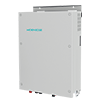
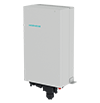
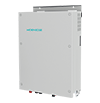
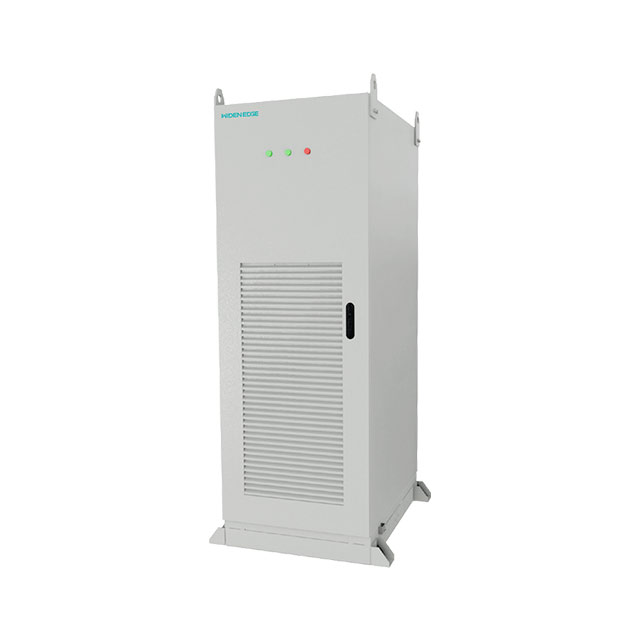
A practical advantage of modular PCS architecture is that power capacity can grow by adding units rather than replacing one very large converter. Our MGC 600kW is designed as a modular energy storage inverter for large-scale microgrid and energy-storage applications. Its DC side supports single-bus and multi-bus configurations, while intelligent cabinet paralleling supports expansion to higher power levels.
That architecture makes synchronization a system-design requirement rather than an isolated inverter function. Every additional unit must use compatible control settings, protection logic, communication arrangements, and electrical connection procedures.
We at WidenEdge also consider physical configuration. The MGC 600kW uses a modular structure and supports side-by-side installation and cabinet-to-cabinet expansion, which can simplify the physical growth of a system as capacity requirements change.
For a 600kW energy storage inverter configuration, engineers should therefore verify more than nominal power. They should examine how many units will operate in parallel, how power sharing is configured, how a new unit synchronizes to the bus, and what happens during load steps or unit outages.
At WidenEdge, we view synchronization as the control foundation that makes modular expansion practical. A well-designed scalable energy storage system does not simply add converters; it adds coordinated voltage-forming resources that can establish a stable common operating point.
Multiple grid-forming PCS units synchronize by coordinating their voltage, frequency, and phase behavior through compatible control strategies, then using mechanisms such as droop control to share active and reactive power. The AC bus provides the electrical environment in which these controllers interact, while synchronization procedures manage the safe connection of additional units.
For a scalable energy storage architecture, successful parallel operation ultimately depends on treating every PCS as part of one controlled system. That means matching control parameters, validating synchronization sequences, accounting for network impedance, and testing the response under realistic operating conditions.
Once those elements are engineered together, adding PCS units becomes a controlled method of increasing microgrid capacity rather than simply connecting more inverters to the same bus.
Return